Johannes Krause is a coastal biogeochemist and seascape ecologist. Focused on coastal vegetated ecosystems, he studies spatio-temporal dynamics of seagrasses, salt marshes, and mangroves using remote sensing techniques, field-based sampling, and predictive modeling. His methodological approach is grounded in a range of disciplines, including environmental chemistry, sedimentology, geospatial analysis, time-series analysis, and bioinformatics. With his research, he strives to uncover how anthropogenic impacts and natural variability affect coastal processes and biogeochemical cycles.
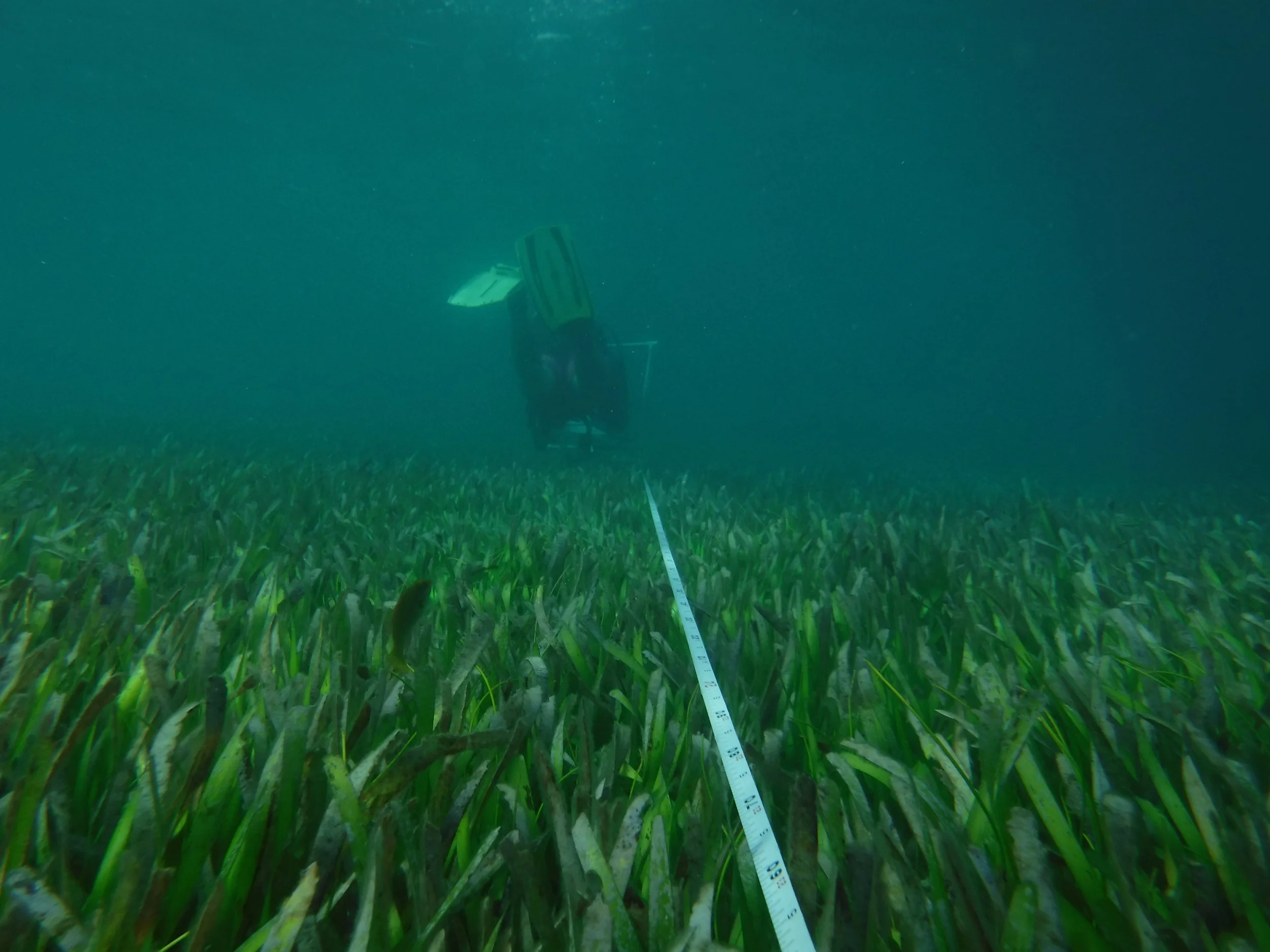
Krause graduated with a BSc in Geo-ecology from the University of Tübingen in Germany. He received his MSc degree in Marine System Science from the University of Glasgow, Scotland, where he studied physiological rates of coralline algae. He joined Dr. Elizabeth Watson’s Coastal Change Lab at Drexel University where he earned a PhD in 2021. Following a postdoctoral appointment with Dr. James Fourqurean at Florida International University, he is currently Assistant Research Professor at FIU studying the effects of coastal environmental change on ecosystem services delivered by seagrasses.
Krause is a lab member of the Seagrass Ecosystems Research Lab at FIU’s Institute of Environment. He is a co-lead of the Vegetation Group of the Florida Coastal Everglades Long-term Ecological Research (FCE-LTER) site and was part of the Coordinated Global Research Assessment of Seagrass Systems (C-GRASS) group of the Scientific Committee on Oceanic Research. Krause co-leads the project management team of the Caribbean Carbon Accounting in Seagrass (CariCAS) network and is working for the seagrass subgroup of the UNESCO/Conservation International’s Blue Carbon Scientific Working Group.
His research has been supported by the National Science Foundation, The Nature Conservancy, Conservation International, Smithsonian Institution, Fauna & Flora International, National Park Service, Environmental Protection Agency, Society of Wetland Scientists, The Wetland Foundation, Geological Society of America, American Philosophical Society, Association of American Geographers, William L. McLean III Fellowship, Claudio Elia Memorial Fellowship, The Gilchrist Trust, The Royal Geographical Society, and Glasgow Natural History Society.
Research Themes
-
There is only one constant: Change. Characterizing temporal and spatial dynamics of habitat configurations across the seascape allows for a deeper understanding of the status and trends of coastal ecosystems and the services they provide.
-
Episodically submerged coastal ecosystems are notoriously hard to observe via optical remote sensing. That is why, in addition to acoustic methods, I explore novel approaches using UAV, high-resolution satellite imagery, machine learning, and cutting-edge image processing techniques to study coastal change.
-
With 200 million people living in the coastal zone globally, our way of life is tightly linked to the nearshore ocean. However, human impacts threaten the ecological integrity of many coastal waters. I am particularly interested in the way nitrogen and phosphorus delivery from terrestrial runoff affects coastal nutrient regimes and elemental cycling.
-
Coastal vegetated ecosystems are recognized as potential sites of carbon sequestration, offering a nature-based approach to mitigate climate change. However, these ecosystems are diverse with complex carbon cycles, where methane production and calcification potentially offset organic carbon burial, warranting meticulous research to inform effective policymaking.

Publications
JR Krause, C Cameron, A Arias-Ortiz, M Cifuentes-Jara, S Crooks, et al. 2025. Global seagrass carbon stock variability and emissions from seagrass loss. Nature Communications. doi:10.1038/s41467-025-59204-4
Janousek CN, JR Krause, JZ Drexler, KJ Buffington, KL Poppe, et al. 2025. Blue carbon stocks along the Pacific coast of North America are mainly driven by local rather than regional factors. Global Biogeochemical Cycles 39(3). doi:10/1029/2024GB008239
Krause JR, A Roden, H Briceño, JW Fourqurean. 2025. Climate oscillations drive nutrient availability and seagrass abundance at a regional scale. Limnology & Oceanography. doi:10.1002/lno.12787
Fourqurean, JW, JR Krause, J González-Corredor, T Frankovich, JE Campbell. 2024. CariCAS Partner’s Practical Field and Laboratory Guide. https://digitalcommons.fiu.edu/merc_fac/32
Fourqurean, JW, JE Campbell, OK Rhoades, CJ Munson, JR Krause, et al. 2023. Seagrass Abundance Predicts Surficial Soil Organic Carbon Stocks Across the Range of Thalassia testudinum in the Western North Atlantic. Estuaries and Coasts. doi:10.1007/s12237-023-01210-0
Krause JR, ME Gannon, AJ Oczkowski, MJ Schwartz, LK Champlin, et al. 2023. Tidal flushing rather than non-point source nitrogen pollution drives nutrient dynamics in a putatively eutrophic estuary. Water 15(1). doi:10.3390/w15010015
Krause JR, AJ Oczkowski, EB Watson, 2023. Improved mapping of coastal salt marsh habitat change at Barnegat Bay (NJ, USA) using object-based image analysis of high-resolution aerial imagery. Remote Sensing Applications: Society and Environment 29. doi:10.1016/j.rsase.2022.100910
Raposa KB, K Wasson, A Woolfolk, C Endris, JR Krause, et al. 2023. Evaluating thin-layer sediment placement as a tool for enhancing tidal marsh resilience: a coordinated experiment across eight U.S. National Estuarine Research Reserves. Estuaries and Coasts. doi:10.1007/s12237-022-01161-y
Krause JR, CC Lopes, SS Wilson, JN Boyer, HO Briceño, JW Fourqurean, 2022. Status and trajectories of soft-bottom benthic communities of the south Florida seascape revealed by 25 years of seagrass and water quality monitoring. Estuaries and Coasts. doi.org/10.1007/s12237-022-01158-7
Krause JR, A Hinojosa-Corona, AB Gray, JC Herguera, J McDonnell, MV Schaefer, SC Ying, EB Watson, 2022. Beyond habitat boundaries: organic matter cycling requires a system-wide approach for accurate blue carbon accounting. Limnology & Oceanography. doi:10.1002/lno.12071
Thomsen AS, JR Krause, M Appiano, KE Tanner, C Endris et al., 2022. Monitoring vegetation dynamics at a tidal marsh restoration site: integrating field methods, remote sensing and modeling. Estuaries and Coasts. (45): 523-538. doi:10.1007/s12237-021-00977-4
Krause JR, A Hinojosa-Corona, EB Watson, 2021. Emerging sensor platforms allow for seagrass extent mapping in a turbid estuary, from the meadow to ecosystem scale. Remote Sensing 13 (18): 3681. doi:10.3390/rs13183681
Krause JR, 2021. Elemental Cycling in Blue Carbon Habitats: Investigations from the Molecular to Ecosystem Scale. PhD Thesis. Drexel University ProQuest Dissertations Publishing. 28411720.
Watson, EB, A Hinojosa-Corona, JR Krause, JC Herguera, J McDonnell, KR Villegas Manríquez, ME Gannon, AB Gray, 2020. Lagoon biogeochemical processing is reflected in spatial patterns of sediment stable isotopic ratios. Journal of Marine Science and Engineering. (8): 874. doi:10.3390/jmse8110874
Krause JR, EB Watson, C Wigand, N Maher, 2020. Are coastal wetlands exposed to nutrient pollution more vulnerable to sea level rise? Wetlands (40):1539-1548 doi:10.1007/s13157-019-01254-8
Powell EB, JR Krause, EB Watson, 2020. Pond excavation reduces coastal wetland carbon dioxide assimilation. JGR: Biogeosciences (125). doi.org/10.1029/2019JG005187